


 Regular priceFrom $5200 AUDUnit priceUnavailable

 Regular priceFrom $5200 AUDUnit priceUnavailable


 Regular priceFrom $5200 AUDUnit priceUnavailable

 Regular price $70000 AUDUnit priceUnavailable

1679/PR-SPARE TIP FOR UNIVERSAL GAUGE
Regular price $3700 AUDUnit priceUnavailable

1679-UNIVERSAL GAUGE WITH CONTACT-ROLL
Regular price $21500 AUDUnit priceUnavailable


Inside or outside, and which one you need
The difference is in the legs. Outside callipers curve inwards, so the tips close around a shaft, a boss or a turned component to take an external diameter. Inside callipers curve outwards, so the tips open into a bore, a groove or a hollow to take an internal measurement. Most workshops keep both, because each one measures what the other cannot reach.
Dividers and trammels for marking out
Precision dividers hold two straight, sharp points for scribing arcs and stepping off repeated distances along a workpiece. When the radius runs beyond a divider’s reach, the 1680 500 trammels take over: a millimetre scale, interchangeable tips and fine tip adjustment to 0.02 mm, which is what makes them worth reaching for on layout work that has to be right the first time.
Choosing your size
The 150 mm callipers suit small turned parts and bench work. The 200 and 250 mm sizes cover most general engineering. The 300 mm is the one to reach for on larger bores and castings, where the extra leg length is the difference between taking a measurement and guessing at one.
Where callipers still beat a digital gauge
A digital caliper is faster and reads to a finer resolution, but it has limits. Callipers reach into grooves and hollow forms a straight jaw cannot enter, they do not mind heat, swarf or coolant, and they hold a setting so you can compare part after part without watching a display. On a lathe or a woodturning bench they are often the quicker tool, not the slower one.
Getting a reading off a calliper
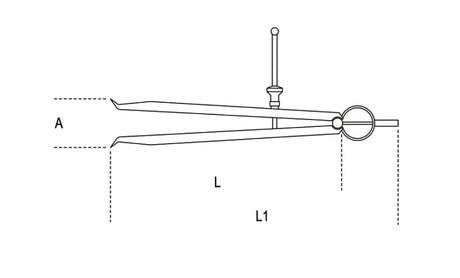
A calliper transfers a dimension rather than displaying it. Set the legs to the work by feel, looking for light drag and no force, then lay them against a rule or a vernier to read the figure. If you want a direct reading instead, the 1679 universal gauge with contact roll reads to 0.1 mm on its own scale.
Frequently Asked Questions
What is the difference between inside and outside callipers?
What is the difference between inside and outside callipers?
Outside callipers have inward-curving legs for external diameters. Inside callipers have outward-curving legs for bores and internal widths.
Which calliper goes on which side?
Which calliper goes on which side?
Outside callipers go around the work; inside callipers go into it. The direction the legs curve tells you which is which at a glance.
What are the main types of calliper?
What are the main types of calliper?
Inside, outside and divider are the three traditional patterns. Vernier, dial and digital callipers are the direct-reading alternatives.
What are dividers and trammels used for?
What are dividers and trammels used for?
Dividers scribe arcs and step off repeated distances. Trammels do the same job across spans a divider cannot reach.
Do callipers need calibrating?
Do callipers need calibrating?
They transfer a measurement rather than display one, so accuracy depends on the rule or vernier you read them against. Keep that instrument calibrated.
Browse the full Beta Tools calliper range, or see the vernier and digital callipers if you need a direct reading.